

![image de [NEW – FIND PhD Thesis] Automating Leak Detection in Nuclear Facilities using Artificial Intelligence](images/news/news4.webp)
Fast and accurate localization of leaks within the primary circuit and the hermetic zones of nuclear facilities is of key importance for safety, since even minor defects in materials or joints can have serious consequences. Within the FIND project, Juraj Kováč’s Ph-D research at the Institute of Robotics and Cybernetics at the Slovak University of Technology in Bratislava, and the Center for Artificial Intelligence, Robotics and Automation at VÚEZ tackles this problem head-on. His research thesis focuses on developing an automated system for locating medium leaks in the primary circuit of nuclear power plants using artificial intelligence.
"Even a small leak can have significant consequences in a nuclear plant, so our goal is to create a system that detects and localizes them as fast as possible, to be able to react rapidly and appropriately to abnormal conditions" says Juraj Kováč, PhD researcher at the Institute of Robotics and Cybernetics, and VÚEZ
Research Methodology: when Machine Learning Meets Thermal-Hydraulics
The central goal of this research is to design a reliable and automated leak localization system that can operate in the complex environment of nuclear power plants. The system developed in the frame of FIND focuses on the primary circuit of nuclear power plants, which is the main water system that carries high temperature pressurised water through the reactor to safely transport heat for electricity production.
To achieve these objectives, the research combines machine learning tools with thermal-hydraulic measurement systems.
First, a static measurement system is installed in the surrounding space to capture and monitor relevant data while the plant is in operation. The system developed by Juraj Kovac in his Ph-D thesis is based on the signal generated by heated thermocouples, which can detect changes in the thermal properties of the fluid. These sensors have various advantages like their accuracy, stability, robustness and low intrusiveness.
Then, the data collected by these thermal-hydraulic sensors is analysed using AI algorithms, which can detect unusual patterns and accurately pinpoint the location of leaks.
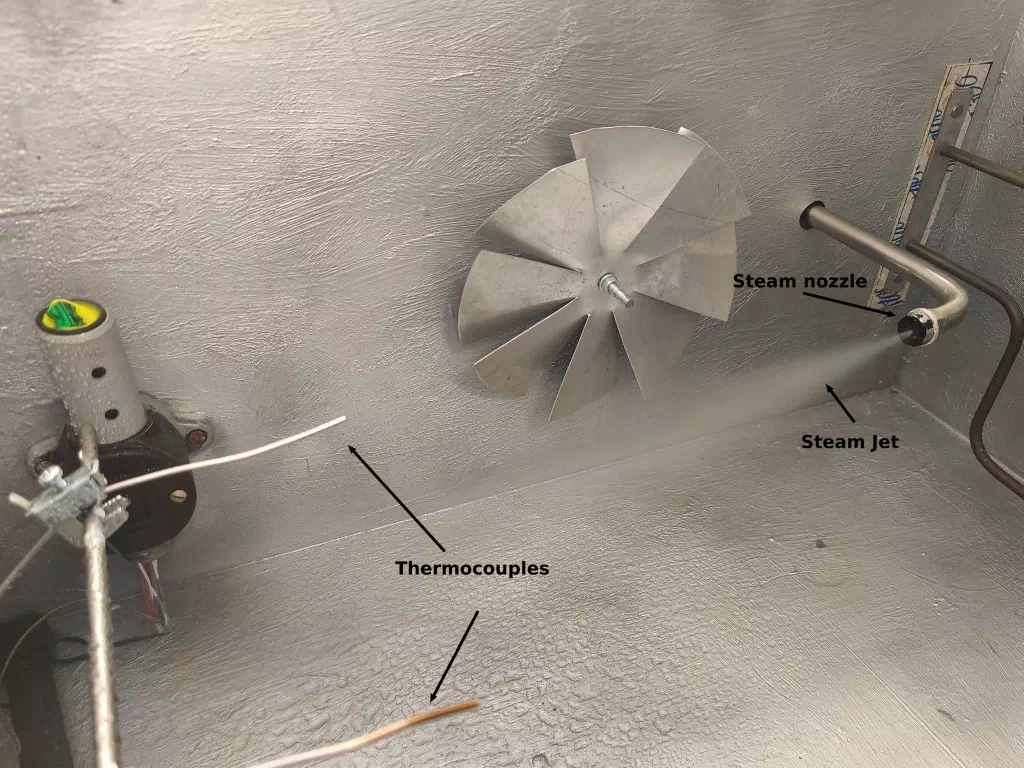
Image from our proof-of-concept experimental setup, showing a nozzle—a device designed to direct and control the flow of a fluid—used to create a focused steam jet aimed at heated thermocouples, which then detected the presence of the steam.
This measurement strategy can easily be extended to other key systems and components containing high temperature water or steam mixture. One can obviously think about the secondary circuit of the reactor (which takes the heat from the primary circuit and turns it into steam to drive turbines and produce electricity), but also about the hermetic envelope (the airtight containment structure surrounding the primary circuit and reactor vessel) of VVER-440 reactors.
Beyond the use-cases explored in FIND, Juraj Kovac also explores the integration of the sensors into a robotic system, allowing control of inaccessible areas during plant outages, and supporting diagnostic and maintenance purposes. This allows engineers to analyse the causes and locations of leaks, helping to prevent future issues and enhance the overall safety of nuclear plants during the production of electricity. This means that the study is not limited to fixed sensors, it also explores the use of robots that can move around inside the plant, allowing inspections in areas that are difficult or hazardous for humans and hard to monitor with stationary sensors. These robots, equipped with the AI-based system, are first tested and validated through simulations to assess their ability to perform automated inspections safely.
Relevance and Expected Outcomes
"By combining fixed sensor data and machine learning analysis, we are working toward the developing the next-generation monitoring systems that make nuclear energy safer, more reliable, and more efficient" explains Juraj Kováč, PhD researcher at the Institute of Robotics and Cybernetics, and VÚEZ
The expected outcomes of this research are highly relevant to both the safety and operational efficiency of nuclear power plants. The automated system promises:
- Rapid and accurate leak detection, helping operators react faster and more accurately in case of accidents.
- Support for maintenance and diagnostic operations, helping engineers assess and improve the tightness of hermetic zones.
- Potential integration with mobile robotic platforms, enabling safer inspections in challenging environments (beyond FIND).
By bridging AI, robotics, and nuclear engineering, this research contributes to the development of next-generation monitoring systems that ensure safer and more reliable nuclear energy production. VÚEZ has long term experience to control the tightness of various systems and components of NPPs, including, pipes, tanks and the hermetic zone of VVER-440 reactors. This experience further strengthens the practical impact and industrial relevance of the work, ensuring that the research outcomes can be directly applied in real nuclear facilities.